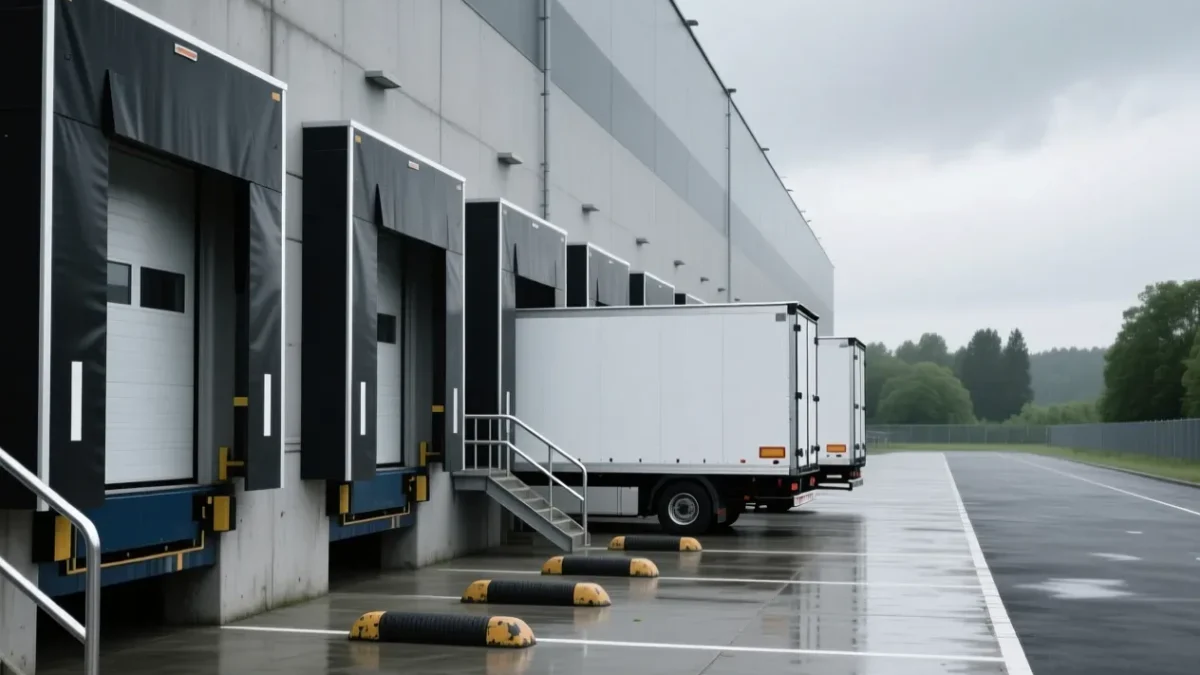
When a foreign investor weighs Slovak industrial and logistics property, the first address that comes to mind is almost always Bratislava and its surroundings. The data for the second half of 2025 tells a different story: the tightest warehouse market in the country is not in the west but in the east. According to CBRE, in the third quarter of 2025 the wider Bratislava region showed a vacancy rate of 6.38 %, western Slovakia stood at 10.25 %, while eastern Slovakia registered only 3.81 % (CBRE, Q3 2025). In other words, the region long seen as the periphery of the logistics map has become its most sought-after segment. This analysis reads industrial property as an asset class through named sources — and states openly where those sources disagree.
Stock and the backbone of the market: the D1 corridor
Slovakia’s modern Class A warehouse stock reached roughly 4.67 million m² by the third quarter of 2025 and, after project completions in the second half of the year, crossed 4.8 million m² (Colliers, Q3 2025). By European standards this is a small but rapidly maturing market, and its geography is defined by a single axis: the D1 motorway corridor connecting Bratislava, Žilina and Košice.
It is along the D1 that new construction and tenant demand concentrate. The market has gradually been shifting from its traditional core near Bratislava toward the east, pulled by new manufacturing capacity. The axis is no accident: for logistics built on just-in-time and just-in-sequence (JIT/JIS) principles, the distance between the warehouse and the assembly line is a direct cost item, and the D1 is the only domestic artery linking all four of the country’s major automotive anchors.
The construction pipeline remains disciplined. According to CBRE and Colliers overviews, some 151,000 to 178,000 m² were under construction in the second half of 2025, of which roughly 79 % was already pre-leased, with completion during 2026 (CBRE/Colliers, 2025–2026). The high pre-lease share is an important signal for investors: developers are building against demand rather than on speculation, which keeps the risk of empty space low.
Vacancy: where the market is tightest
Vacancy is the single most important measure of a rental market’s health — and the point where the methodologies of individual advisers diverge most visibly. At the national level, Colliers reports a vacancy rate of roughly 7.72 % for the third quarter of 2025, its highest reading in years; after strong leasing at year-end it fell to about 7.40 % in the fourth quarter of 2025 (Colliers, Q3–Q4 2025). CBRE works from a different base and reports vacancy of around 7.97 % for the third quarter of 2025 (CBRE, Q3 2025). These two figures cannot be averaged — they rest on different definitions of „modern stock,“ different geographic boundaries for the Bratislava region, and a different treatment of completing projects. Investors should track the trend, which is the same in both cases (a mild rise through the year and a decline at the close), rather than a single „correct“ value.
The regional breakdown is analytically more valuable than the national average. According to CBRE, in the third quarter of 2025 the highest vacancy was in western Slovakia (10.25 %), followed by the central region (9.30 %) and the wider Bratislava area (6.38 %). Eastern Slovakia stood at just 3.81 % (CBRE, Q3 2025) — a level that signals an almost fully occupied market. This west-east gap is the heart of the year’s investment story: while the west holds a cushion of empty space, the east has virtually none.
Demand, moreover, has more than one face. Colliers reports that in the fourth quarter of 2025 net take-up reached 82,496 m², with renewals of existing leases accounting for up to half of total demand (Colliers, Q4 2025). A high share of renewals suggests that tenants are staying — a more stable income profile for an asset holder than a market driven by relocations.
Rents: two figures, two sources
Prime rent — the highest achievable rate for the best space in the best location — is the second point where CBRE and Colliers diverge, which is why this analysis states it twice. CBRE works with a prime rate of roughly €5.30/m²/month for 2026, having quoted as much as €5.80/m²/month earlier in 2025; the average rate ran at about €4.70/m²/month on CBRE’s numbers (CBRE, Q4 2025 – 2026). Colliers reports prime rent of approximately €5.40/m²/month as of the fourth quarter of 2025, with an average headline rate of around €5.07/m²/month (Colliers, Q4 2025).
The gap between €5.30 and €5.40/m²/month is not a measurement error — it is the product of different methodologies. The advisers define which buildings belong in the „prime“ category differently, draw the boundaries of the Bratislava market differently, and treat net versus gross take-up differently. For a financial model this has a practical consequence: a rent should always be read together with the name of the adviser and the quarter it applies to, not as a single universal number. Averaging the two values would create a figure that appears in no source at all.
In absolute terms, Slovak rents remain competitive within Central Europe. A prime rate just above €5/m²/month is sensitive to quality and location, but the spread between prime and average — roughly €0.60 to €0.70/m²/month on both advisers‘ data — shows that the market is not yet fully polarised and that older stock still finds tenants.
Why capital is flowing into the sector
Investment activity confirms that a tight rental market is translating into buyer appetite. According to CBRE, investment into Slovak industrial and logistics property rose by roughly 315 % year on year in the first half of 2025, while total commercial real estate investment increased by about 170 % over the same period (CBRE, H1 2025). Such figures should be read with care — a high year-on-year rate partly reflects a low 2024 comparison base — but the direction is unambiguous: capital is returning to a sector that was cautious for two years.
Real manufacturing sits behind the demand for space. Slovakia is a long-standing world leader in car production per capita, and the automotive industry accounts for an estimated 13 % of GDP and roughly 33 % of industrial exports (ZAP SR, 2024). Four large assembly plants — Volkswagen in Bratislava, Kia near Žilina, Jaguar Land Rover near Nitra and Stellantis in Trnava — create steady pressure on logistics halls in their catchments. Each pulls behind it a layer of Tier 1, Tier 2 and Tier 3 suppliers who need warehouses within reach of the line.
The east of the country adds a new element to this picture. Volvo Cars is building its fifth European plant near Košice — an investment of roughly €1.2 billion with capacity for up to 250,000 electric vehicles a year (Volvo Cars Media, 2026). This capacity explains why vacancy in the east is only 3.81 % (CBRE, Q3 2025): supply and logistics chains are positioning into the region even before full production ramps up. It should be noted, however, that the plant’s timing differs between sources — Economy Minister Denisa Saková spoke of test vehicles „at the turn of summer and autumn 2026“ (STVR, 2026), while Volvo Cars in its own statement refers to the start of series production „in 2026“ (Volvo Cars Media, 2026). Both formulations are left here exactly as their sources state them.
What it means for the investor and the finance team
From an investment standpoint, the Slovak industrial market looks squeezed at both ends of the spectrum. In the west there is a cushion of empty space that gives tenants bargaining power; in the east the market is so tight that supply, not demand, sets pricing. Prime rent of around €5.30 to €5.40/m²/month (CBRE / Colliers, Q4 2025 – 2026), combined with a high pre-lease share in the pipeline, points to a market that is healthy but no longer cheap.
The tax environment also enters the model. From 1 January 2025 the top rate of corporate income tax rose to 24 % for taxable income above €5 million (Act No. 595/2003 Coll., effective 1 January 2025), while smaller entities with income up to €100,000 pay 10 %. At the same time the standard VAT rate rose from 20 % to 23 % (Act No. 222/2004 Coll., effective 1 January 2025). Both changes affect a project’s net return and a tenant’s operating calculations, and therefore belong in every real estate financial model, not only in a tax return.
Sustainability is a growing driver of value. Across the region, BREEAM certification has become the de facto standard specification of new warehouse stock rather than a premium add-on — almost every new hall is now delivered with a „green“ certificate (IPEC Group, 2025). A concrete example is the new facility operated by CEVA Logistics and Jungheinrich in Plavecký Štvrtok, north of Bratislava, completed to the BREEAM Excellent standard (CEVA Logistics, 2025). By estimate, a certified warehouse cuts energy and water consumption by roughly 20 to 40 % against an older uncertified building, with the efficiency package paying back in around 3 to 5 years (IPEC Group, 2025) — an estimate, not an audited figure. For the investor this turns certification from a marketing plus into a precondition of lettability and a component of tenants‘ own ESG reporting.
Labour completes the cost picture. The average nominal monthly wage in the Slovak economy reached €1,620 for the full year 2025 (Statistical Office of the Slovak Republic, 2025), while in industry — the largest employment sector — it stood at €1,884 gross per month in the fourth quarter of 2025 (Statistical Office of the Slovak Republic, Q4 2025). Wages are rising but remain well below German and Austrian levels, keeping the operating economics of logistics and light manufacturing attractive to western tenants.
Conclusions
Slovakia’s industrial and logistics real estate market enters 2026 as a small but matured segment with a clear geography. Three findings stand out. First, the centre of gravity has moved east: vacancy of just 3.81 % near Košice (CBRE, Q3 2025) is the product of new manufacturing capacity, not a short-term swing. Second, the vacancy and rent figures differ between advisers — national vacancy of 7.72 % on Colliers‘ data versus 7.97 % on CBRE’s for Q3 2025, prime rent of €5.40/m²/month per Colliers versus €5.30/m²/month per CBRE — and these differences should be read as a consequence of methodology, not as a contradiction. Third, capital is returning to the sector (industrial investment up 315 % year on year in H1 2025 per CBRE), yet the 2025 tax changes and rising sustainability demands are reshaping the return calculation.
For a foreign investor this implies a simple discipline: read every figure with the name of the adviser and the quarter it applies to, follow the trend rather than a single value, and distinguish between a looser west and a tight east. Slovakia remains a competitive Central European destination for logistics and light manufacturing — but its property market is no longer a one-city story.
This article is for general information only and does not constitute legal, tax or financial advice.