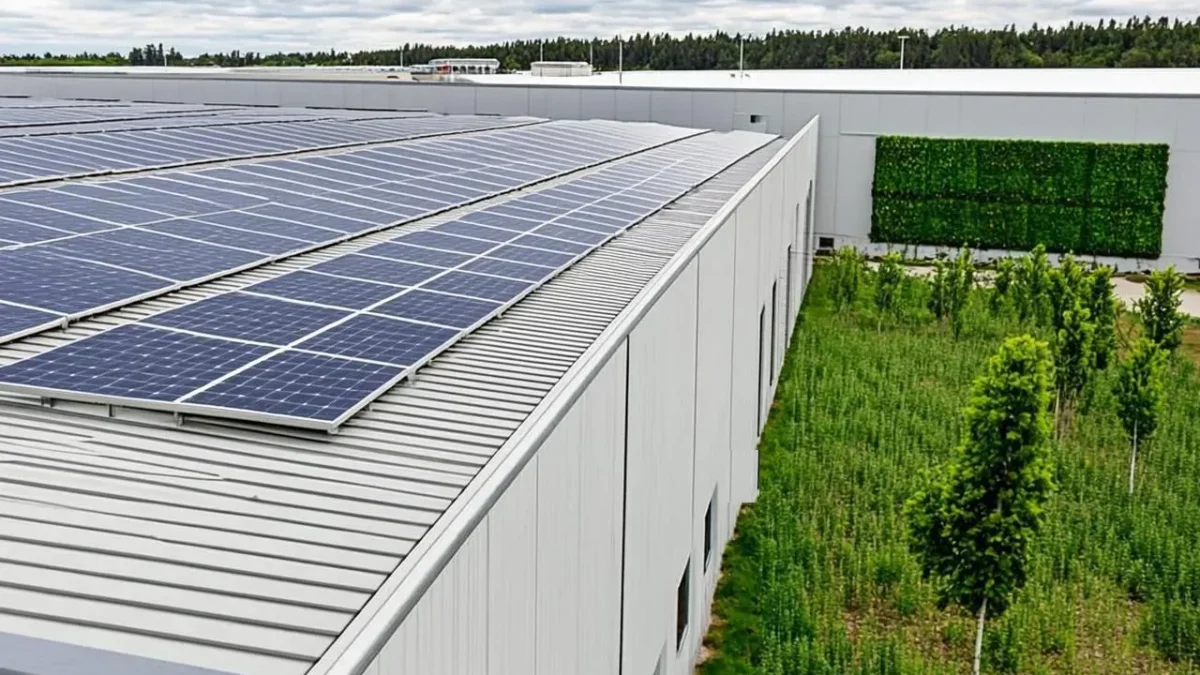
The question an investor in Central European industrial property asked only a few years ago was: how much extra does a „green“ hall cost, and whether such a premium ever pays off. In 2026 the question has been turned on its head. A sustainability certificate has stopped being an optional add-on for which the landlord charges a premium and has become the base specification of new warehouse stock. The more relevant question today is therefore not „how much does the certificate cost“ but „how much does its absence cost“ — in the form of a narrower pool of tenants, more expensive financing and faster building obsolescence. This shift has direct consequences for anyone in Slovakia who leases, buys or builds a logistics hall.
How „green“ became the norm
The most striking change of recent years is not that green buildings became more expensive, but that they stopped being the exception. According to an analysis by IPEC Group, across the Central European region BREEAM has become the de facto standard specification for new warehouse stock rather than a premium option — almost every new hall is now handed over with some form of „green“ certificate (IPEC Group, as of 2025; this is a market thesis of the advisory group, not a verified statistical figure). In other words, what was a differentiator five years ago has since moved into the category of an expected minimum.
This development follows the broader logic of the market. Developers building for multinational tenants and institutional buyers have found that an uncertified building leases worse and sells worse, and so they built certification into the standard brief before the foundations were even laid. The certificate has thus stopped being a marketing argument for the landlord and become a condition of entry into the selection process on the side of both the tenant and the fund. That is precisely why it makes sense to speak of a criterion, not a premium.
What BREEAM and LEED actually measure
BREEAM (Building Research Establishment Environmental Assessment Method) and LEED (Leadership in Energy and Environmental Design) are the two most widespread international schemes for assessing the environmental quality of buildings. The first is operated by the British organisation BRE, the second by the American U.S. Green Building Council. Both assess a building across several areas — energy efficiency, water consumption and management, materials, waste, pollution, location and transport, and the health and well-being of users — and summarise the result in a graded rating.
BREEAM uses a scale from Pass through Good, Very Good and Excellent up to Outstanding; LEED has the levels Certified, Silver, Gold and Platinum. The exact point thresholds for the individual levels and their weighting are set by the scheme operator (BRE and USGBC respectively) and differ across methodology versions and project types; this article therefore does not present them as fixed numbers and refers readers to the current methodology of the relevant scheme. For logistics halls in Slovakia the most commonly relevant variant is BREEAM New Construction, which assesses a building during the construction phase. What matters for the investor is that the certificate is not a one-off sticker — it says something about parameters that directly affect the tenant’s operating costs and the carbon footprint reported in the tenant’s disclosures.
The Slovak reality: the certificate as part of new stock
The Slovak industrial and logistics market is large enough for this standard to carry over to it in full force. Total stock of modern class A warehouses reached approximately 4.67 million m² in the third quarter of 2025 according to Colliers Slovakia, and after completions in the second half of the year was expected to exceed 4.8 million m² (Colliers Slovakia, as of Q3 2025; secondary aggregator, recommended to verify against the original quarterly report). Across this stock, new completions are handed over with a sustainability certificate almost across the board.
A concrete example is the new facility of CEVA Logistics and Jungheinrich in Plavecký Štvrtok in the Bratislava North park, roughly 30 km from Bratislava, which obtained a BREEAM certificate at the Excellent level under the New Construction scheme (CEVA Logistics, press release, 2025). It illustrates a wider pattern: multinational 3PL operators and manufacturers now approach a new hall in such a way that certification is part of the brief, not an afterthought.
Geographic context matters too. The core of the Slovak market remains the D1 motorway corridor between Bratislava, Žilina and Košice, towards which tenant demand is shifting (IPEC, as of 2026; recommended to verify against the geographic breakdown from CBRE/Colliers). New, certified stock is arising precisely along this axis, while older, uncertified halls in less attractive locations face the risk of ending up outside the interest of creditworthy tenants. The distinction between „green“ and „brown“ stock thus partly overlaps with the distinction between new and old, between the D1 corridor and the periphery.
The economic dimension: a premium, or rather a penalty for its absence
The economics of a certified building should be read on two levels — operational and value-based. On the operational side, according to estimates a certified warehouse reduces energy and water consumption by roughly 20 to 40 % compared with an older uncertified building, with the payback on the package of energy-efficiency measures estimated at three to five years (IPEC, as of 2025; this is an estimate of the advisory group, not an audited figure, so we present it as indicative). These savings fall primarily on the tenant, who pays the operating costs, and become an argument when deciding into which hall to place their operation.
On the value side the situation is less straightforward. A precise „green premium“ on rent or on the capital value of industrial assets in Slovakia cannot yet be quantified with a single reliably substantiated figure, and this article does not invent one. Rather than a measurable mark-up, it is a shift in liquidity and financeability: a certified building has a wider pool of potential tenants and buyers and easier access to sustainability-linked financing, while an uncertified building faces an implicit discount — a „brown penalty“ — in the form of narrower demand and faster functional obsolescence. This thesis is for now more of a forming market consensus than a hard-measured value.
The framework in which this plays out is, moreover, exceptionally active. Investment in Slovak industrial and logistics property rose by approximately 315 % year on year in the first half of 2025 according to CBRE (CBRE, as of H1 2025; advisory source, recommended to verify against CBRE’s original investment figures). The leasing market continued to grow into 2026 as well: in the first quarter of 2026 net take-up rose by roughly 35 % year on year and prime rent settled at 5.80 €/m²/month, while average rent fell slightly to around 4.65 €/m²/month (CBRE, as of Q1 2026). For comparison, Colliers reported a prime rent of 5.40 €/m²/month for the fourth quarter of 2025 and CBRE 5.30 €/m²/month for 2026 in an earlier reading — the methodologies of the two advisers differ in the definition of „modern stock“ as well as in geographic boundaries, so we do not average these values and always cite them with the adviser and the quarter. In such an overheated market, where vacancy stood at approximately 7.4 % for the fourth quarter of 2025 according to Colliers (Colliers, as of Q4 2025), the qualitative difference between a certified and an uncertified building feeds into decision-making faster than it would in a stagnant market.
Why tenants and funds demand it
Demand for „green“ stock does not arise from the ecological conviction of developers, but from a chain of obligations that is triggered at end brands and retailers and flows down through logistics operators to landlords. 3PL service providers and manufacturers today carry their own decarbonisation targets imposed on them by their customers; the warehouse is a large item in the reported carbon footprint within indirect emissions (Scope 3), and so the certificate changes from an add-on into a reporting necessity (IPEC, as of 2025; secondary source, expert interpretation).
This pressure also has a legislative anchor. The CSRD directive (2022/2464) was transposed into Slovak law by an amendment to the Accounting Act — Act No. 105/2024 Coll., effective from 1 June 2024 — which introduced mandatory sustainability reporting under the European ESRS standards (LeitnerLeitner/Kinstellar, as of 2024; secondary source, wording recommended to verify on Slov-Lex). The first wave concerns the largest public-interest entities for periods from 1 January 2025. The scope and timing of the obligation are, however, currently changing: the so-called Omnibus package pushes back deadlines for part of the large enterprises and reassesses the thresholds (Kinstellar/Mondaq, as of 2025) — since the relevant EU legislation is still being finalised, the specific state should be verified as at the date of the decision, and this article therefore presents it only in outline.
Regardless of the exact thresholds, a practical consequence holds: even smaller Slovak suppliers serving large automotive manufacturers are, through the supply chain and buyers‘ requirements, effectively drawn into the sustainability-reporting agenda. The certificate of the building in which their operation is located thus becomes one of the data points they must be able to document. On the funds‘ side the logic is a mirror image — institutional investors with their own ESG mandates prefer assets that fit into their reporting without friction, and an uncertified building becomes harder for them to place.
What this means for the investor and the tenant
For both the investor and the tenant on the Slovak industrial market, several sober conclusions follow from the above. First, BREEAM or LEED certification has, in the segment of new logistics halls, moved from a premium add-on to the position of a standard; its absence is today a stronger signal than its presence. Second, a tangible part of the certificate’s economics lies in the tenant’s operating savings — indicatively 20 to 40 % on energy and water according to advisers‘ estimates — and in the liquidity and financeability of the asset, not in an easily quantifiable rental mark-up, which cannot yet be substantiated in Slovakia by a single reliable figure.
Third, demand for green stock is driven by a chain of obligations from end brands through logistics to CSRD legislation, and is therefore not a cyclical fluctuation that will disappear once the market cools. Fourth, the risk is shifting onto older, uncertified halls outside the D1 corridor, which face faster functional obsolescence and a narrower pool of creditworthy tenants. And finally, since part of the key parameters — from the point thresholds of the certification schemes through the scope of CSRD obligations to the methodologically differing figures on rent and vacancy — are continuously changing or differ between sources, every investment decision should rest on verifying the current state in the primary source as at the day it is made, not on an average from secondary overviews.
A green certificate is thus not a story about environmental virtue, but about a changing structure of demand and risk on a market that has grown at double-digit rates over the past year. An investor who reads it as a criterion, and not as a premium, navigates this market more precisely.
This article is for general information only and does not constitute legal, tax or financial advice.