Moving production closer to the market it serves — nearshoring — is most often sold to foreign investors as a cost story: lower wages, shorter transport, fewer customs surprises. Slovakia complicates that reading. The average nominal monthly wage in the economy reached 1,620 euros for the full year 2025, up 6.3 percent year on year (Štatistický úrad SR, full year 2025). In manufacturing, the sector that employs the most people, the average gross wage in the fourth quarter of 2025 stood at 1,884 euros, 6.7 percent higher than a year earlier (Štatistický úrad SR, Q4 2025). A country that is supposed to be cheap is, in fact, getting more expensive. And supply chains keep flowing into it anyway. The explanation lies not in the price of labour but in the density of anchors.
This article follows one contrarian thesis, and it runs against the usual marketing of development agencies: nearshoring to Slovakia is not primarily wage arbitrage but gravity around large final vehicle manufacturers. Where a plant stands that takes in thousands of parts a day at a precise moment, a supplier does not relocate for cheap labour — it relocates because it physically has to be close. That proximity is what makes Central Europe a hard node to replace.
Automotive as an anchor, not just a sector
The first argument is statistical. Slovakia has long led the world in cars produced per capita: in 2024, roughly 182 vehicles were built per 1,000 inhabitants (figures aggregating OICA and the Automotive Industry Association of the Slovak Republic, ZAP SR, 2024). The automotive sector accounts for around 13 percent of GDP, 54 percent of industrial output and 33 percent of industrial exports (ZAP SR, 2024). This is not one sector among many — it is the load-bearing structure of the economy.
Nor is the output volume merely historical momentum. After a weaker 2024, when about 993,000 vehicles left the lines (down from 1.08 million in 2023, ZAP SR), production recovered in 2025 to around 1.07 million units (ZAP SR, full year 2025). For an investor weighing where to place a supplier plant, what matters is not a single year but the fact that final manufacturers‘ demand for parts holds in a band around a million vehicles a year — and that this demand is geographically anchored in four, soon to be five, specific points on the map.
Four plants, one gravity
The density of anchors is unusually high in Slovakia’s case. On a relatively small territory, four large final assembly plants operate, each with its own field of suppliers.
Volkswagen in Bratislava produced roughly 341,000 vehicles in 2024 and remains the oldest and most complex carmaker in the country (VW Slovakia / ZAP SR, 2024). Kia in Žilina reached a record 351,270 vehicles in 2024 and launched production of its first fully electric model, the EV4, in 2025 (Kia Slovakia / ZAP SR, 2024–2025). Jaguar Land Rover near Nitra and Stellantis in Trnava each produced on the order of 150,000 vehicles in 2024, with the Trnava plant undergoing a change in its model portfolio (ZAP SR, 2024).
The JLR plant near Nitra is a textbook example of how an anchor forms. The launch investment reached roughly 1.3 billion euros, the plant opened in October 2018, and by 2023 it employed about 5,000 people, having built more than 365,000 Defender and Discovery vehicles (JLR Media Newsroom, 2023). In January 2025 the JLR group announced a global investment of 65 million pounds, part of which extends capacity in Nitra, and it confirmed a shift to electric production by 2030 (JLR Media Newsroom, 2025). Every such capacity decision is a signal to dozens of suppliers that it pays to be physically nearby — and once built, a supplier network relocates slowly and expensively.
The fifth anchor: Volvo near Košice and the dispute over timing
A fifth point is now being added to this structure, one that shifts the centre of gravity from the south-west to the east of the country. Volvo Cars is building its fifth plant near Košice — its first fully electric and, according to the company, climate-neutral facility. The investment is cited at around 1.2 billion euros, with a planned capacity of up to 250,000 electric vehicles a year and potential expansion to 500,000 (Volvo Cars Media press release; also confirmed by Economy Minister Denisa Saková, 2026). State aid for the project was approved by the European Commission in April 2024. Under the investment contract, employment is to grow from roughly 600 people in 2026 by a further 700 by year-end, and up to 3,300 workers by 2028 (STVR / D. Saková, 2026).
On the timing of the production start, however, the sources diverge, which is why this article does not present it as a single figure. Economy Minister Denisa Saková stated in 2026 that the plant will begin producing its first test vehicles at the turn of summer and autumn 2026 (STVR RSI, 2026). Volvo Cars‘ own press communication, meanwhile, refers to the start of series production in 2026 (Volvo Cars Media). Some secondary outlets say only „opening in 2026,“ without distinguishing the test phase from series production. The gap between „test vehicles in autumn 2026“ and „series production in 2026“ is not cosmetic: for a supplier, it determines when orders at volume actually begin. Both formulations therefore stand here side by side with their sources; reconciling them is a matter for the company and the state, not for this editorial desk.
Why anchors pull supply chains
The mechanism that keeps suppliers close is operational, not accounting-based. Automotive assembly runs on just-in-time and just-in-sequence logistics (JIT/JIS): parts do not arrive into a warehouse but straight onto the line, in the exact order and at the exact moment. A seat, a bumper or a wiring harness that must be on the line in the right vehicle in the right minute cannot be reliably shipped across half a continent. So Tier 1 suppliers settle within driving distance of the plant, and Tier 2 and Tier 3 follow behind them. A single anchor thus creates a multi-layered network whose value grows the denser and better-drilled it becomes.
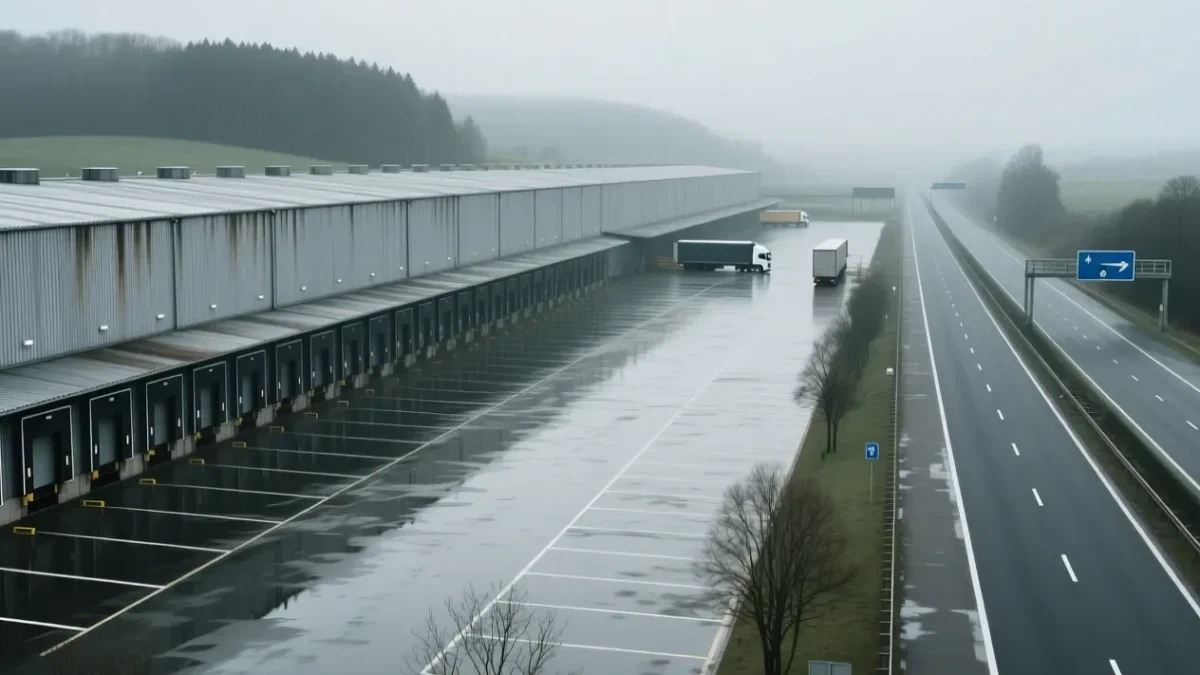
This logic feeds directly into demand for industrial real estate. The backbone is the D1 motorway corridor linking Bratislava, Žilina and Košice, along which most modern halls and logistics parks are concentrated (based on the geographic breakdown from CBRE/Colliers, 2026). A signal of tightness in the east is warehouse vacancy: according to CBRE, in the third quarter of 2025 it stood at just 3.81 percent in the eastern part of the country — the lowest of any region, well below the wider Bratislava region (6.38 percent), the centre (9.30 percent) and the west (10.25 percent) (CBRE, Q3 2025). Low vacancy near Košice is a readable trace of space being taken up even before a new anchor reaches full ramp-up.
The east adds a second layer of logic. Eastern Slovakia is positioning itself as a logistics gateway toward the east, thanks to a combination of new automotive infrastructure, energy capacity and a distinctive broad-gauge rail link that connects networks beyond the eastern border through the trans-shipment hub at Čierna nad Tisou (based on trade-press analyses, 2025). This desk presents that purely as an infrastructure fact, without geopolitical judgement; for siting production, however, it is a real parameter of market access.
The economic dimension: not the cheapest, but the best-anchored
Return to the opening paradox. If Slovakia is not the cheapest and wages are rising, what does it compensate with? The answer has three components, and not one of them is „cheap labour.“
The first is proximity to the anchors themselves, described above — a value that a competitor without comparable density of final manufacturers simply cannot offer. The second is public support tuned toward higher value added. The SARIO agency administers investment incentives for new and expanding projects in manufacturing, business service centres and technology centres, with a regional state-aid map that favours priority districts and higher value-added projects (SARIO, 2025). To this is added a tax instrument aimed at innovation: a research and development super-deduction allows an additional deduction of up to 100 percent of eligible R&D expenditure (SARIO / state R&D support, 2025). The specific aid intensities by region follow the regional investment-aid document, and an investor should verify them for the given district rather than estimate.
The third component is a predictable tax environment, although it changed from 2025. The corporate income tax rate has been tiered since 1 January 2025: 10 percent for taxable income up to 100,000 euros, 21 percent in the band from 100,000 euros to 5 million euros, and 24 percent above 5 million euros (based on tax summaries of the amendment to Act No. 595/2003 Coll., in force from 1 January 2025). The top rate for the largest entities thus rose from 21 to 24 percent, while smaller and mid-sized operations benefit from the reduced 10 percent rate at a higher threshold. The exact wording of the thresholds and definitions should be verified directly in the Act; for the logic of nearshoring, what matters is that the tax burden remains competitive for most supplier operations and is graduated by size.
The sum of these components explains why rising wages do not stop the inflow. An investor is not paying for the lowest wage on the map, but for the shortest distance to five anchors, for support tied to value added, and for predictable rules. The price of labour is only one variable in an equation dominated by operational proximity.
Conclusions
Several conclusions follow from the facts, stated soberly and with a source attached to every figure:
1. Nearshoring to Slovakia is an anchoring story, not a low-wage story. The average manufacturing wage rose 6.7 percent year on year to 1,884 euros in Q4 2025 (Štatistický úrad SR, Q4 2025), and yet demand to site production persists. What decides is the density of final manufacturers, not the price of labour.
2. The automotive anchors are concentrated and significant. Four plants — VW Bratislava, Kia Žilina, JLR Nitra, Stellantis Trnava — hold the sector at around 13 percent of GDP and 33 percent of industrial exports (ZAP SR, 2024), with total output near 1.07 million vehicles in 2025 (ZAP SR, 2025).
3. The fifth anchor shifts the centre east, but its timing remains disputed. Volvo Cars near Košice (investment about 1.2 billion euros, capacity up to 250,000 EVs a year, up to 3,300 workers by 2028) is the largest new variable. Two different formulations stand on its timing: „test vehicles at the turn of summer and autumn 2026“ (STVR / D. Saková, 2026) and „series production in 2026“ (Volvo Cars Media). This desk does not reconcile them.
4. Industrial real estate demand tracks the anchors. Warehouse vacancy in the east fell to 3.81 percent in Q3 2025 (CBRE, Q3 2025), clearly below the national average — space is being taken up before production reaches full ramp-up.
5. Public support is targeted, not blanket. SARIO investment incentives and the R&D super-deduction of up to 100 percent of eligible costs (SARIO, 2025) favour higher value added; their specific parameters should be verified for the given district and project.
For a foreign manufacturer or investor, the practical brief is this: assess a location not by the wage table but by distance to existing anchors, by the density of the supplier network along the D1 corridor, and by which incentive actually applies to the specific district. These are the variables that decide whether a supply chain really relocates into Central Europe — and whether it stays there.
Sources & data
Štatistický úrad SR (wages, full year and Q4 2025) · Automotive Industry Association of the Slovak Republic, ZAP SR / OICA (output and sector share, 2024–2025) · Volvo Cars Media and STVR RSI (Volvo Košice — investment, capacity, employment, timing, 2026) · JLR Media Newsroom (Nitra, 2023–2025) · CBRE / Colliers Slovakia (vacancy and geography of industrial real estate, Q3–Q4 2025) · SARIO (investment incentives and R&D super-deduction, 2025) · tax summaries of Act No. 595/2003 Coll. (CIT, in force from 1 January 2025). Every figure carries the date it applies to; the divergent statements on Volvo’s production start are presented separately and left unreconciled.
This article is for general information only and does not constitute legal, tax or financial advice.